The Leadership Gap That Gets More Expensive as You Grow
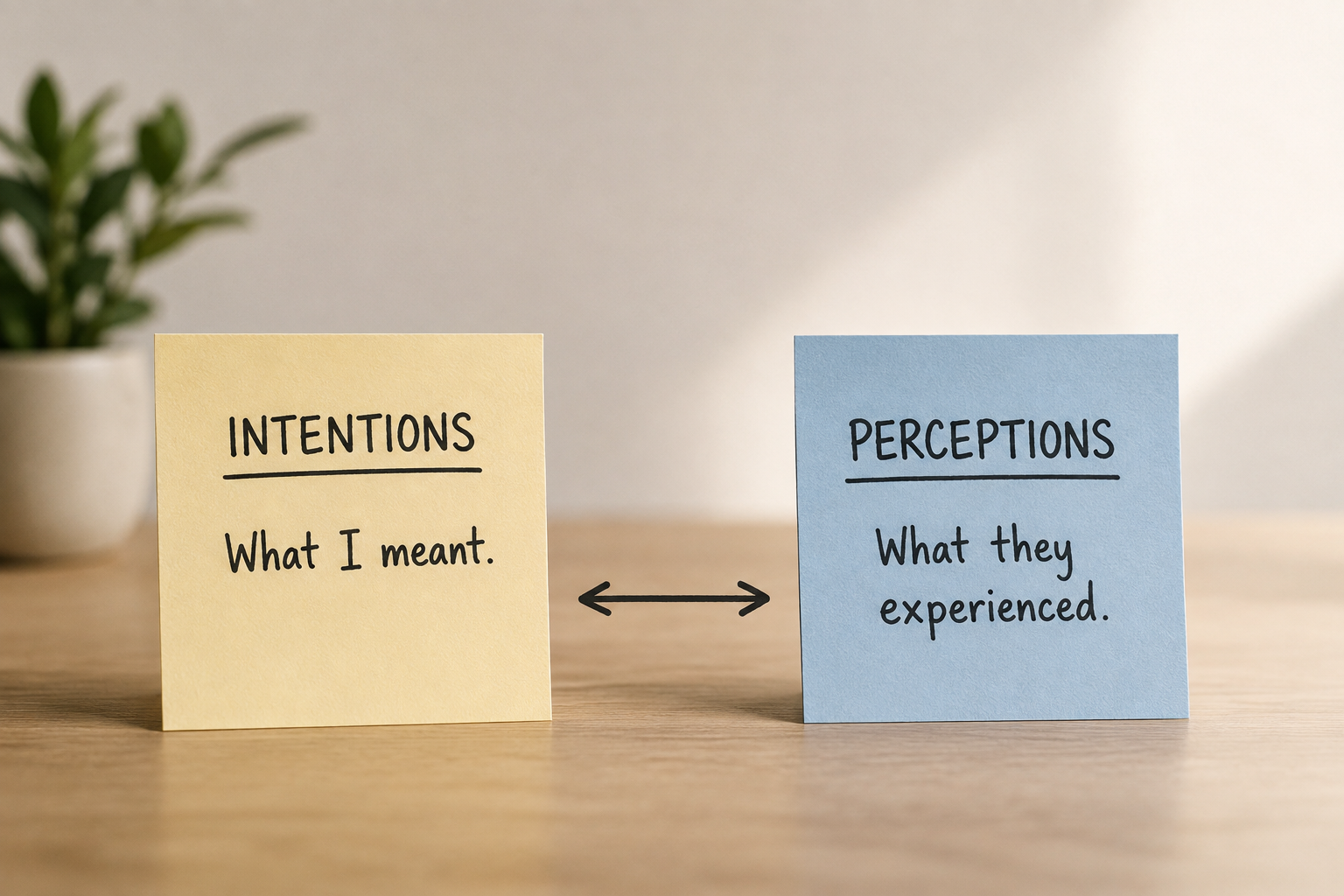
“Intentions don’t penetrate perceptions.”
I heard that phrase recently, and it has stuck. I talk with leaders all the time about the gap between intent and impact. This takes it one step further. As a leader, you know what you meant. You know why you made the decision, what you were trying to communicate, and what you hoped people would understand. Everyone else is working from what they experienced.
We evaluate our own communications by our intentions. But, others evaluate our communications by their impact.
As companies grow, perception carries more weight
In a smaller organization, leaders have more chances to clarify things in real time. They can walk down the hall, explain what they meant, or pull someone into a quick conversation when something starts to go sideways.
As the company gets bigger, that becomes harder. Leaders are farther away from more conversations and decisions, so people rely more heavily on the patterns they experience. When those patterns are inconsistent, the cost shows up in rework, slower decisions, more escalation, and feedback that comes later than it should.
I see this play out in a few very common ways. A senior leader says, “I want managers to own more,” and means it. He genuinely wants people making decisions without him.
Then a client gets upset, or the decision carries more risk than expected, and he steps back in. Maybe he reverses the call. Maybe he takes over because it feels faster (and just easier) in the moment. After that happens a few times, managers adjust. They start checking more often and waiting for approval on decisions they could probably make themselves.
The leader still believes he wants more ownership. But the team has learned from experience where the real boundary sits.
The same thing happens when a leader says, “I want people to challenge me.” She may absolutely mean it, but then someone disagrees in a meeting, and she becomes defensive, moves on quickly, or spends the next 5 minutes explaining why her original idea still makes sense.
People notice those moments. They learn which topics are worth challenging, how much disagreement is safe, and when it is easier to stay quiet and have the real conversation later. And it is often subconscious.
Clarity has its own version of this. “I thought I was clear” is one of the most common things I hear from leaders, and usually they were clear in their own heads. The problem is what everyone else received.
One person heard urgency. Someone else thought the deadline was flexible. A third person assumed someone else owned the next step. Those gaps can look small in the moment, but across a growing organization they create a lot of unnecessary work.
What to look for
A useful place to start is with one leadership intention you care about and then look at what people have actually experienced.
Ask yourself:
If I want managers to own more, what happened the last time someone made a decision I disagreed with?
If I want people to challenge me, how did I respond the last time they did?
If I believe I am clear, what are people actually doing after the conversation?
If I want feedback to happen sooner, how quickly am I giving mine?
These questions get you out of what you meant and into what people can actually see and respond to.
Build consistency into how leadership works
This is one reason I’ve become so focused on the Trusted Leadership Operating System. As a company grows, people need more consistency in how leadership works.
They need to know how decisions get made, what happens when people disagree, how meetings are run, when feedback happens, what behaviors get addressed, and what speaking up actually looks like.
When leaders handle those situations consistently, employees have something dependable to work from. They don’t have to keep interpreting which version of the rules applies based on who is leading the meeting or how much pressure everyone is under that day.
Growth magnifies inconsistency
A smaller organization can rely on informalities for longer than people realize because leaders carry context in their heads, step into conversations when needed, and smooth over inconsistencies personally.
Eventually that becomes too much to carry. Growth magnifies the small inconsistencies that used to be manageable, and the leadership system has to carry what informalities used to solve.
A good place to start is simple:
Pick one leadership behavior you care about.
Look back over the last 30 days.
Ask what your team actually experienced.
Notice where your actions and your intention may have drifted apart.
Decide what needs to become more consistent.
So the question I’d ask is this: Where might your team be experiencing something different from what you believe you are communicating?